Image - 2026-09-23 06:43
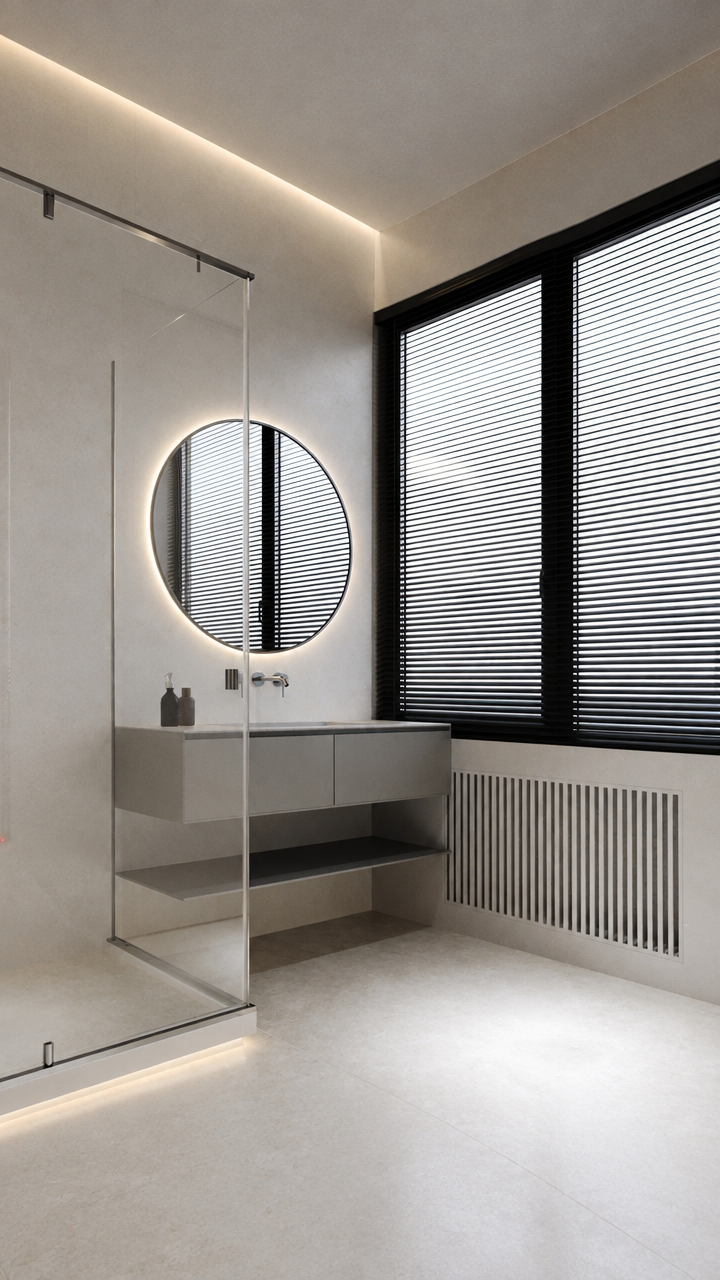
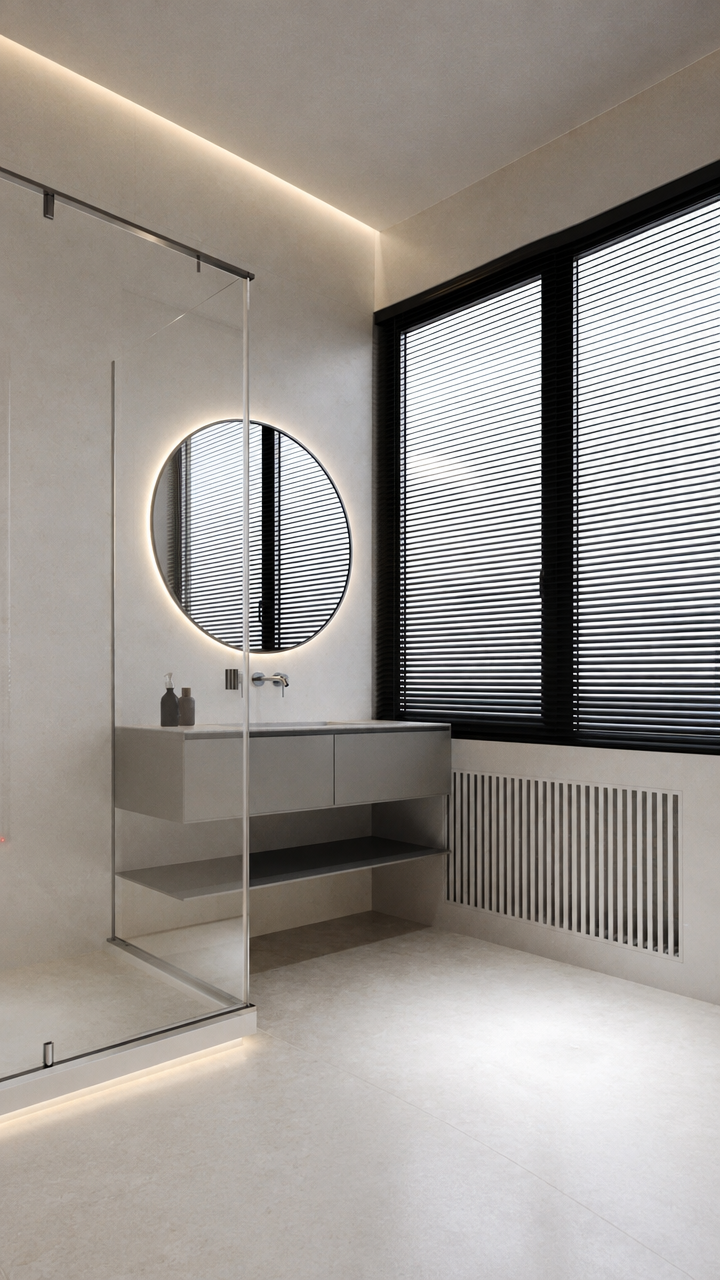
IMAGE-TO-IMAGE / OUTPAINTING — NATIVE 9:16 PORTRAIT ADAPTATION Use the supplied reference image as the strict visual and architectural source. IMPORTANT: This is NOT a redesign and NOT a new bathroom generation. Adapt the existing photograph into a true 9:16 vertical composition while preserving the original bathroom, architecture, objects, materials, proportions, perspective and camera position. The final image must look as if the SAME bathroom was originally photographed vertically with a real consumer camera. COMPOSITION: native 9:16 portrait aspect ratio, true vertical photographic composition, no stretching, no squeezing, no artificial crop, no panoramic-to-portrait distortion. Preserve the original framing and visual hierarchy: - large black-framed window with horizontal blinds on the right - round backlit wall mirror on the left - floating minimalist vanity beneath the mirror - clear glass shower enclosure in the foreground/left - pale stone floor - vertical radiator / slatted heating panel beneath the window - minimalist white/beige walls - warm indirect LED lighting along the ceiling - all existing fixtures and architectural elements Keep every existing object in exactly the same relative position and with physically correct proportions. Do not redesign the bathroom. Do not change the location of: the mirror, the vanity, the window, the blinds, the shower glass, the radiator, the floor, the ceiling lighting. 9:16 EXTENSION: Reconstruct the missing image area naturally rather than cropping the original. Extend the existing architecture vertically and horizontally only where necessary to create a balanced 9:16 frame. Continue: - the ceiling - wall surfaces - window frame - black window mullions - horizontal blinds - shower glass - floor - LED light strips - wall textures - radiator geometry All extensions must connect seamlessly with the original pixels and perspective. The generated areas must be visually indistinguishable from the original photograph. CAMERA: same camera position as reference, same camera height, same viewing direction, same perspective, moderately wide consumer optical lens, deep depth of field, natural architectural perspective, straight but imperfect real-world vertical lines, no fisheye, no extreme wide-angle distortion. The camera should feel like an inexpensive early-2000s digital consumer camera / Handycam rather than a modern professional architectural camera. PHOTOGRAPHIC STYLE: early-2000s consumer Handycam video aesthetic, small CCD sensor, compact built-in optical zoom, deep depth of field, slightly soft digital detail, modest electronic sharpening, slightly saturated consumer colors, limited dynamic range, bright highlights clipping naturally, realistic automatic exposure, subtle CCD noise, very subtle chromatic aberration, slight lens softness, minor exposure imperfections, authentic handheld camera character, slightly imperfect amateur framing, raw unpolished digital-video texture, real photographic imperfections, no cinematic color grading. The photograph should feel like a real person casually filmed this bathroom with a budget consumer camera. LIGHT: Preserve the existing lighting exactly. Warm indirect LED illumination along the ceiling remains subtle. Natural daylight enters through the large window. The blinds create realistic horizontal light patterns. Allow bright areas near the window to clip slightly, as they would on a small CCD sensor. Maintain realistic soft shadows and reflections. Do not create dramatic cinematic lighting. Do not add studio lighting. Do not make the image excessively bright or HDR-like. MATERIALS: Preserve the original materials: matte warm-white walls, light stone surfaces, minimalist pale vanity, dark charcoal/black window frames, horizontal black blinds, transparent glass, chrome hardware, pale flooring, subtle warm LED strips. Materials must have real physical texture. Glass must have realistic transparency and subtle reflections. Metal must have imperfect natural reflections. The stone must have subtle tonal variation. The walls should have very fine real-world texture rather than perfectly smooth CGI surfaces. WINDOW: The large black-framed window is one of the dominant architectural elements. Preserve: - exact black frame structure - horizontal blinds - spacing between blind slats - realistic perspective - natural daylight - subtle exterior brightness The blinds must remain perfectly coherent with the window perspective. Do not invent scenery outside the window. Keep the exterior mostly bright and indistinct, consistent with the original exposure. SHOWER: Preserve the transparent frameless shower enclosure. Maintain: - glass thickness - metal rails - vertical glass edge - floor connection - reflections - transparency Do not generate additional shower panels. Do not duplicate glass. Do not bend the glass. VANITY: Keep the floating vanity exactly as shown. Preserve: - horizontal proportions - drawer divisions - open lower shelf - countertop - wall mounting - minimalist geometry Do not add handles or redesign the cabinetry. MIRROR: Preserve the circular mirror exactly. Keep: - circular geometry - thin dark frame - subtle warm backlight - realistic reflection of the window blinds The mirror reflection must obey physically correct reflection geometry. NO AI ARTIFACTS: No warped architecture. No duplicated objects. No floating objects. No impossible reflections. No melted edges. No distorted blinds. No irregular window frames. No bent mirror. No asymmetric circular mirror. No deformed vanity. No distorted glass. No duplicated radiator. No random bathroom accessories. No artificial plants. No invented furniture. No strange geometry. NEGATIVE PROMPT: no redesign, no new bathroom, no different interior, no changed architecture, no changed camera angle, no changed perspective, no changed furniture, no changed fixtures, no additional objects, no duplicated objects, no missing objects, no warped geometry, no bent walls, no curved walls, no distorted window, no distorted blinds, no warped mirror, no oval mirror, no distorted vanity, no distorted shower glass, no duplicated glass panels, no duplicated shower, no duplicated fixtures, no floating objects, no impossible reflections, no incorrect reflections, no broken perspective, no fisheye, no ultra-wide distortion, no stretched image, no squeezed image, no horizontal image cropped into portrait, no artificial vertical extension, no visible outpainting seams, no CGI, no 3D render, no architectural visualization, no Unreal Engine, no Blender, no Octane render, no V-Ray render, no glossy showroom appearance, no hyperrealistic CGI, no HDR, no excessive dynamic range, no cinematic color grading, no teal and orange, no excessive sharpness, no oversharpening, no plastic surfaces, no perfect textures, no procedural textures, no repeated patterns, no AI-looking details, no text, no logos, no labels, no watermark, no timestamp, no UI. FINAL INSTRUCTION: The final result must be a faithful native 9:16 photographic adaptation of the supplied reference. It must look like the exact same bathroom photographed vertically from the same position with the same camera, not like a newly generated bathroom. Preserve the original image wherever possible. Generate only the missing areas required to achieve the 9:16 composition. Prioritize architectural continuity, object fidelity, perspective accuracy and photographic realism over adding new details.
Free to start · Generate videos and images with AI in seconds
More from this creator


More Gpt Image 2.5 images
См. все →