Image - 2026-09-24 04:54
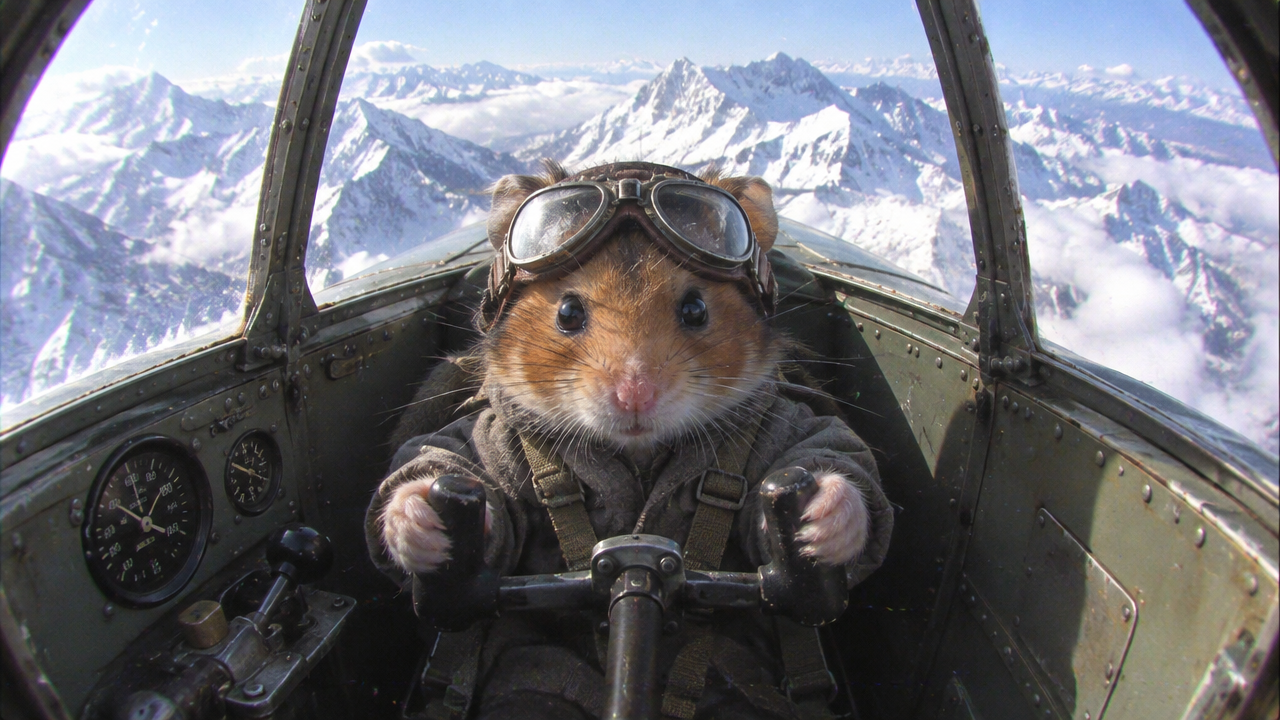
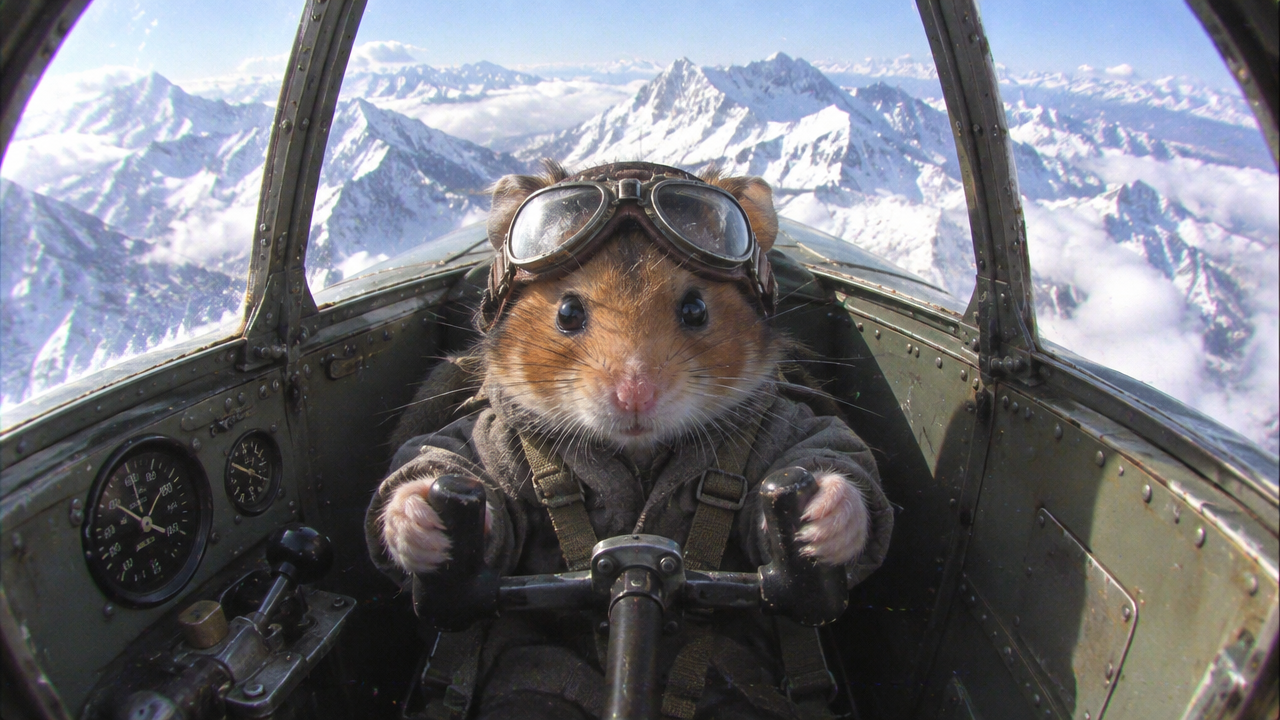
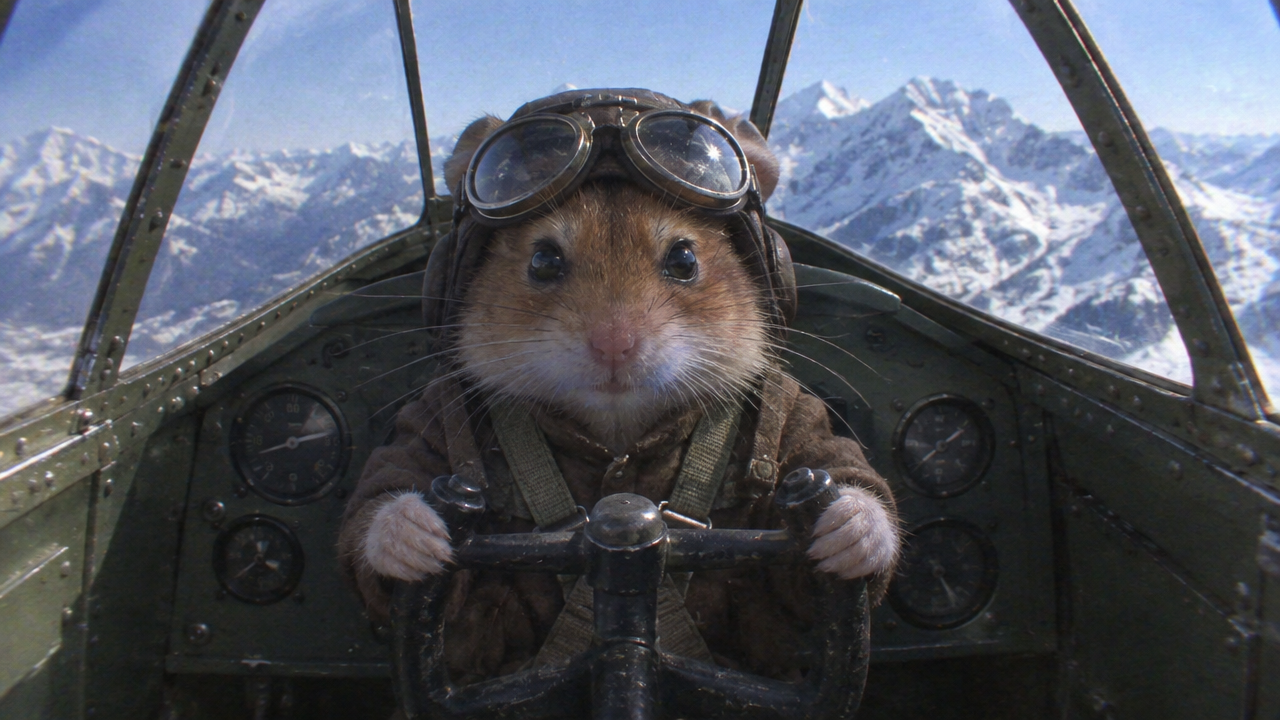
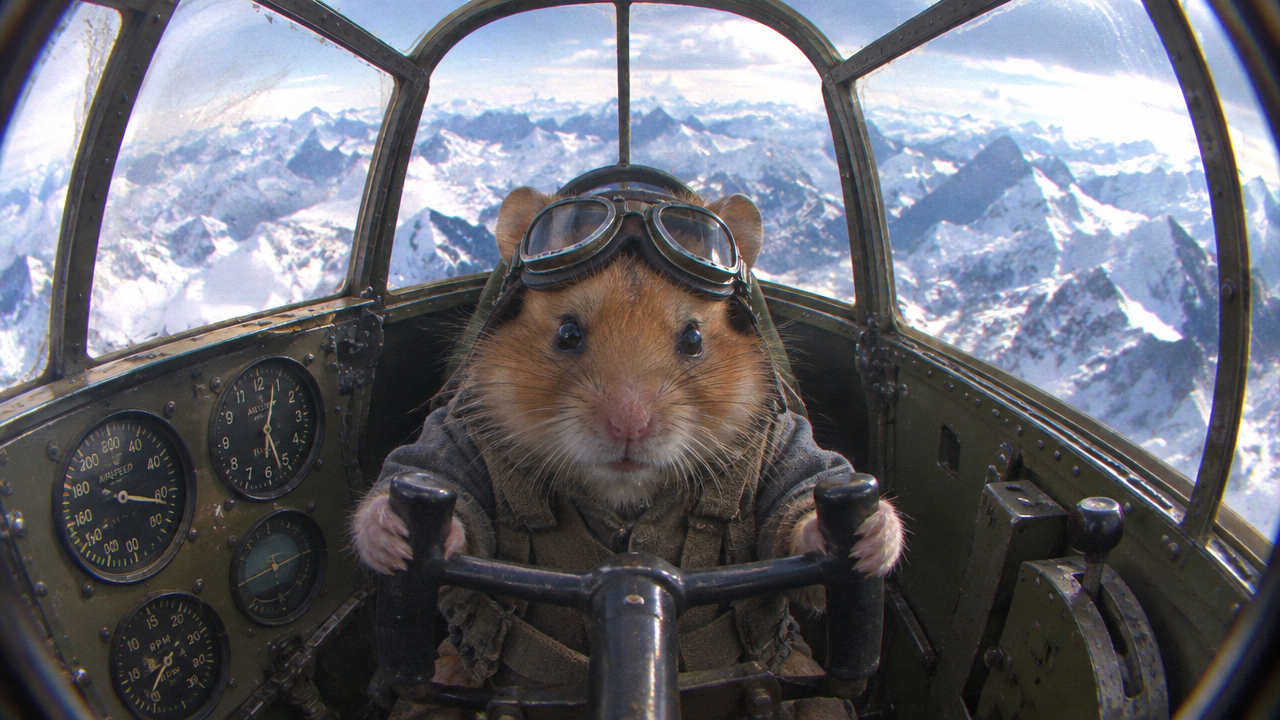
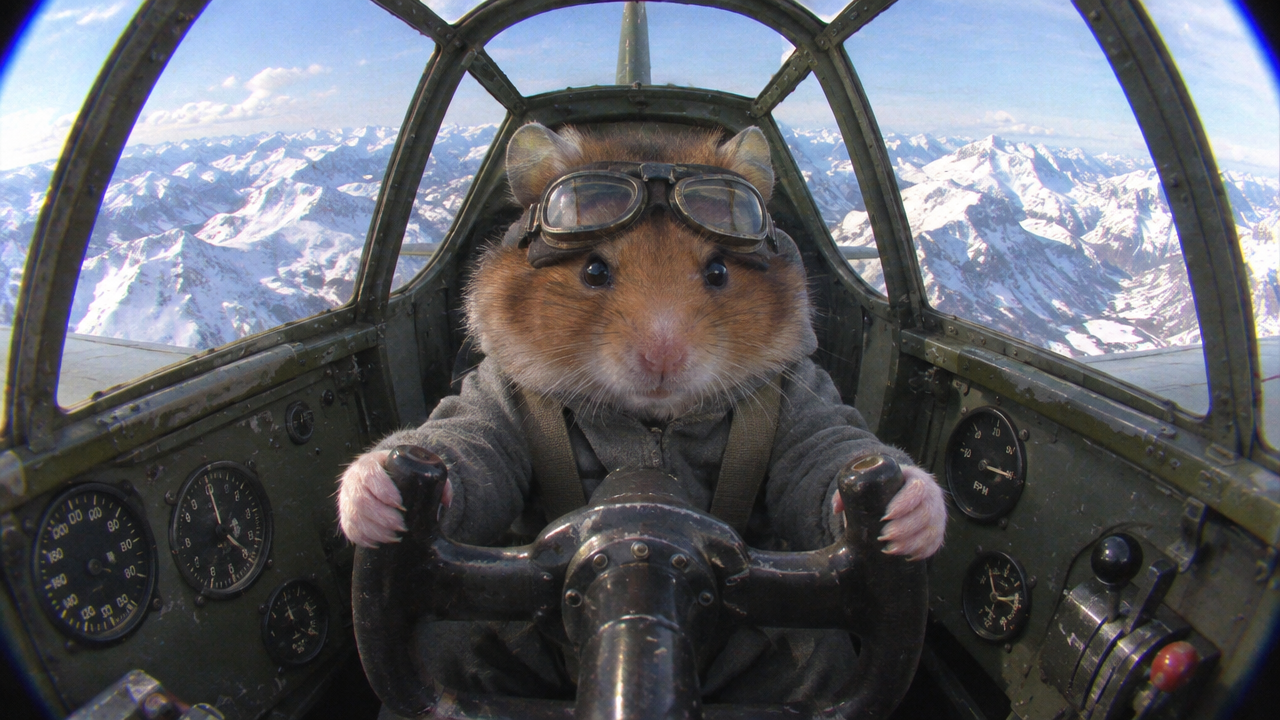
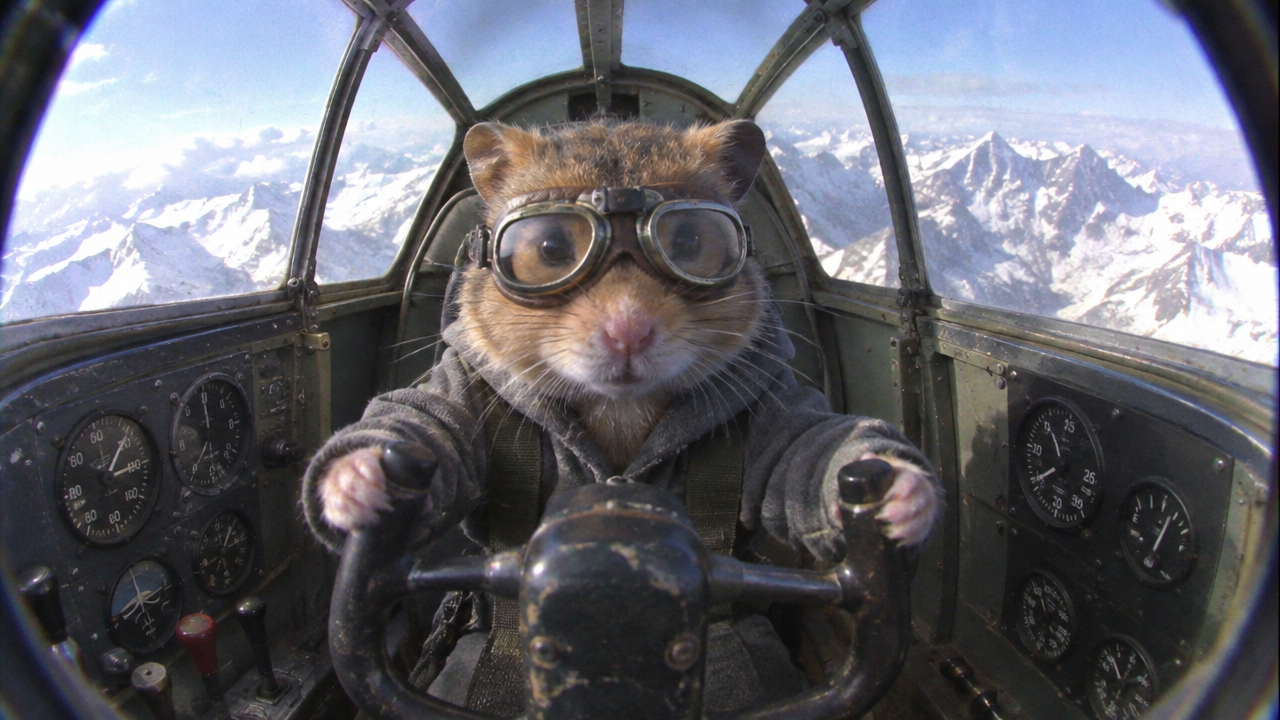
Use the attached image as the PRIMARY VISUAL REFERENCE and preserve its successful composition, camera position, hamster placement, fisheye perspective, mountain background and overall visual atmosphere. Create a photorealistic 16:9 horizontal image based directly on this reference. The goal is NOT to redesign the scene. The goal is to preserve what already works exceptionally well while making the aircraft cockpit substantially more realistic, mechanically coherent and historically believable, and giving the hamster a much stronger emotional performance. ================================================== CORE VISUAL TARGET ================================================== Preserve the exact overall visual idea of the reference: A small real hamster sits alone inside an old WWII-era piston aircraft cockpit, wearing vintage aviator goggles and a worn gray pilot outfit. He is flying over enormous snow-covered mountains. The camera is physically mounted inside the cockpit directly in front of him. The image looks like authentic 1990s Hi8 / Video8 consumer camcorder footage recorded during an actual flight. The scene feels like a forgotten piece of archival home-video footage. The hamster is tiny and vulnerable. The aircraft is old. The mountains are enormous. The moment feels like his final flight. The emotional tone is: heroic, tragic, exhausted, isolated, quietly terrifying, determined, epic. Do NOT show death. Do NOT show a crash. Do NOT show injuries. Do NOT show blood. The emotional power comes from the feeling that death MAY be imminent. ================================================== PRESERVE THE SUCCESSFUL COMPOSITION ================================================== Keep the same frontal centered composition as the reference image. The camera remains directly on the aircraft's central longitudinal axis. The camera is physically mounted inside the cockpit. The camera is approximately 60–80 cm in front of the hamster. The camera is approximately at the hamster's eye / upper-chest height. The optical axis points directly at the hamster. The hamster remains almost exactly in the optical center. The hamster remains centered between the left and right cockpit structures. The flight controls remain in the lower central foreground. The snowy mountains remain visible through the windshield directly behind the hamster. Both sides of the cockpit remain visible. Do NOT change the camera to a cinematic side angle. Do NOT use a three-quarter view. Do NOT use an over-the-shoulder shot. Do NOT move the camera outside the aircraft. Do NOT use an external aircraft shot. Do NOT change the framing dramatically. Do NOT make the hamster smaller. Do NOT make the hamster larger. Do NOT change the basic composition. The reference composition is already correct. ================================================== FISHEYE LENS — PRESERVE ================================================== Preserve the characteristic vintage fisheye perspective from the reference. Real physical vintage wide-angle / fisheye lens. Approximately 16–20mm full-frame equivalent. Strong but controlled barrel distortion. The cockpit sidewalls and canopy frames naturally curve toward the edges. The outer edges of the cockpit are noticeably stretched by the optical geometry. The central area around the hamster remains comparatively natural. The hamster's face and body remain near the optical center and therefore are only minimally distorted. The foreground controls appear slightly larger because of the wide-angle lens. The fisheye must look like real optical lens distortion. NOT a digital fisheye filter. NOT a spherical warp. NOT extreme distortion. No circular black fisheye border. ================================================== HAMSTER — EXACT CHARACTER ================================================== Use the hamster from the reference image as the exact character. Preserve his recognizable appearance. Real brown / golden hamster fur. Individual hairs. Natural fur density. Natural whiskers. Round ears. Pink nose. Large dark eyes. Realistic hamster anatomy. Realistic small-animal proportions. Natural paws. Do not turn him into a generic mouse. Do not turn him into a rat. Do not turn him into a squirrel. Do not make him anthropomorphic in facial anatomy. He remains physically a real hamster. The only anthropomorphic action is that he is capable of operating the aircraft controls. ================================================== AVIATOR GOGGLES ================================================== Preserve the vintage aviator goggles. Real leather strap. Old glass lenses. Subtle scratches. Slight optical reflections. Natural fit around the hamster's face. The goggles should look like a tiny functional piece of old aviation equipment. Do not make them oversized. Do not make them cartoonish. Do not make the lenses perfectly clean and digitally sharp. ================================================== PILOT CLOTHING ================================================== Preserve the gray oversized clothing from the reference. Worn but believable fabric. Slight dust. Subtle wrinkles. Natural folds around the shoulders and arms. Slightly worn cuffs. Do not make the clothing filthy. Do not make it ragged. Do not add medals. Do not add military insignia. Do not add logos. Do not add text. ================================================== EMOTION — MAJOR PRIORITY ================================================== Transform the hamster's neutral expression into a subtle but extremely powerful expression of impending finality. He looks like he knows this may be his last flight. He is exhausted. He is frightened. He is mentally overwhelmed. But he is still completely focused on flying. His determination is stronger than his fear. His eyes are slightly wider than normal. His pupils are focused straight ahead through the windshield. His eyelids are tense. His facial muscles show subtle strain. His ears are slightly pulled back from stress. His whiskers show slight tension. His mouth remains naturally closed. No screaming. No crying. No cartoon tears. No exaggerated sadness. No open-mouth expression. No melodramatic facial expression. He should look like a real animal experiencing extreme stress while trying to remain focused. The emotional message should be: "He knows this may be the end, but he refuses to let go." His eyes should contain a mixture of: fear, fatigue, determination, resignation, and courage. The viewer should immediately feel protective of him. The emotion must be subtle enough to remain photorealistic. ================================================== BODY LANGUAGE — FINAL FLIGHT ================================================== The hamster's entire body reinforces the emotion. Both paws grip the controls firmly. The paws visibly wrap around the grips. Natural hamster paws. No human fingers. His grip is tense. His forearms and shoulders show subtle strain. His shoulders are slightly raised. His body leans slightly forward. His posture is rigid from concentration. His clothing pulls naturally around his shoulders and arms. His head remains centered. He is physically exhausted but refusing to surrender. His gaze remains fixed straight ahead. He does not look at the camera. He does not look down at the instruments. He does not look toward the viewer. He is watching the mountains ahead. ================================================== AIRCRAFT DESIGN ================================================== The aircraft must look like ONE coherent, real WWII-era piston-engine aircraft design. Do NOT create a generic "military cockpit". Do NOT combine unrelated aircraft components. Use the visual language of a real mass-produced WWII-era aircraft. The aircraft is a compact piston-engine aircraft with a historically plausible cockpit and period-correct flight controls. The cockpit is designed around actual flight operation. It is lightweight. Functional. Compact. Mechanically simple. The aircraft is old but fully operational. Avoid unnecessarily identifying a specific aircraft model if doing so would introduce incorrect components. The design should instead remain internally consistent with a real WWII-era piston aircraft. ================================================== COCKPIT STRUCTURE — REAL ENGINEERING ================================================== Improve the cockpit from the reference while preserving its overall shape and framing. The cockpit is constructed from realistic aircraft materials: painted aluminum sheet metal, formed aluminum panels, structural frames, riveted joints, period-correct fasteners, thin metal brackets, worn leather, rubber seals, aircraft glass. The panels have believable thickness. The panels physically connect to each other. The sidewalls connect naturally to the fuselage. The instrument panel is structurally attached to the cockpit. The windshield frame is structurally integrated into the aircraft. The canopy frames have believable thickness. Every visible structural component must have a plausible physical connection. No floating panels. No impossible intersections. No objects passing through other objects. No decorative structural elements. No futuristic construction. The cockpit should look manufactured, assembled and maintained by real aircraft mechanics. ================================================== INSTRUMENT PANEL — SIMPLIFY AND IMPROVE ================================================== The instrument panel is one of the most important areas to correct. Make it realistic by making it restrained. Do NOT add more instruments. Use only a small number of believable mechanical analog flight and engine instruments. The instruments should not form a perfect grid. The left and right sides should NOT be mirrored. The panel should have a naturally asymmetrical functional arrangement. Use several larger primary flight instruments. Use a smaller number of secondary engine and system instruments. Different gauge diameters. Different bezel depths. Different mounting depths. Natural spacing. Some instruments slightly recessed. Some instruments slightly angled according to the panel geometry. Some portions of the panel remain plain painted metal. Empty metal space is desirable. The panel should NOT look packed. The panel should NOT look like a spaceship. The panel should NOT look like a modern aircraft. The gauges should be physically recessed into the metal. Real glass faces. Realistic black or dark instrument bezels. Period-appropriate typography on the gauges, but too small and soft to be prominently readable. No modern digital readouts. No LCD. No LED displays. No screens. No radar. No modern navigation system. No multifunction display. No touchscreen. No electronic avionics. No random sensors. No fictional gauges. No duplicate gauges. No decorative gauges. No meaningless circular objects. If a gauge cannot be justified as a real aircraft instrument, omit it. ================================================== CONTROL SYSTEM — CRITICAL ================================================== Preserve the general central-control composition from the reference, but make the control mechanism substantially more realistic. The control yoke must NOT resemble an automobile steering wheel. It must NOT look like a truck steering wheel. It must NOT be oversized. Reduce its visual mass. Use a lightweight period aviation control yoke with believable metal construction and dark worn grips. The central control column must be relatively thin. The column must emerge naturally from the lower cockpit structure. The yoke must be mechanically connected to the column. The mechanism must look capable of actually controlling an aircraft. The central mechanism should NOT be a huge cylindrical industrial object. No giant central housing. No decorative bolts covering the entire mechanism. No exaggerated mechanical complexity. The hamster's paws must physically grip the actual control grips. ================================================== SECONDARY CONTROLS ================================================== Only a small number of period-correct mechanical controls are present. A believable throttle / engine-control arrangement may be visible beside the pilot. Small mechanical levers. Simple knobs. Believable mounting plates. Realistic spacing. Every control must have a clear purpose. Remove unnecessary controls. Do NOT add mysterious red handles. Do NOT add unexplained emergency levers. Do NOT add fictional mechanical boxes. Do NOT add decorative switches. Do NOT add random knobs. Do NOT add rows of buttons. Do NOT add modern control consoles. ================================================== WIRING AND MECHANICAL DETAILS ================================================== Keep wiring extremely restrained. Only small amounts of wiring or mechanical linkage should be visible where naturally exposed. Every visible wire must have a believable origin and destination. Every mechanical linkage must connect actual components. No giant cable bundles. No random wires. No wires going nowhere. No random pipes. No hoses going nowhere. No exposed machinery for visual decoration. No fictional mechanisms. If uncertain: DO NOT INVENT IT. A plain metal surface is better than a fake mechanical component. ================================================== CANOPY AND WINDSHIELD ================================================== Preserve the excellent canopy geometry from the reference. Improve only its physical construction. Real WWII aircraft windshield. Thin aircraft glass. Metal structural frames. Believable frame thickness. Natural joints. Real fasteners. Small scratches. Minor glass imperfections. Subtle reflections. Natural optical distortion. The fisheye lens causes the canopy frames to curve toward the edges. The canopy must feel physically attached to the aircraft. No futuristic bubble canopy. No modern cockpit glass. No excessive reflections. ================================================== AIRCRAFT WEAR ================================================== The aircraft has been heavily used. It shows authentic age. But it is operational. Use: faded paint, small scratches, minor chipped paint, slightly worn metal edges, subtle oxidation, light dust, small grease marks, worn leather, slight discoloration around frequently touched areas. The areas around the control grips and throttle should show slightly more wear because they are frequently handled. Do not make everything equally dirty. Wear should follow actual use. No random grime. No uniform dirt overlay. No destroyed cockpit. No crash damage. No fire damage. No severe rust. No broken instruments. No missing panels. No shattered glass. ================================================== MOUNTAINS — EPIC SCALE ================================================== The mountains remain exactly as important as in the successful reference. Huge snow-covered alpine mountain range. Massive peaks. Sharp rocky ridges. Deep valleys. Snow-covered slopes. Distant layers of mountains. Cold atmospheric haze. Soft clouds between the peaks. The mountains should feel enormous compared with the tiny aircraft. The hamster should appear physically vulnerable against this environment. The landscape should be majestic, cold and indifferent. The mountains are not fantasy mountains. Real geological forms. Natural aerial perspective. Natural snow distribution. Natural atmospheric haze. No impossible floating peaks. No fantasy landscape. No battlefield. No explosions. No fire. No smoke. No enemy aircraft. ================================================== LIGHTING — EPIC BUT REAL ================================================== Cold high-altitude daylight. Bright reflected light from the snow illuminates the hamster naturally. The cockpit is darker than the exterior. The hamster's face is readable despite the shadow. The snowy mountains are bright but not completely blown out. Slight highlight blooming is acceptable because of the old CCD sensor. Natural reflected blue-white light from the snow. Subtle reflections in the goggles. Subtle reflections in the windshield. The hamster should have slightly more light on his face than the surrounding cockpit because of natural snow reflection. No artificial spotlight. No Hollywood key light. No dramatic colored rim light. No orange-and-blue lighting. No fantasy lighting. The epic feeling comes from the natural mountain environment and the emotional moment. ================================================== 1990s HI8 / VIDEO8 CAMERA ================================================== The entire image must look like genuine 1990s consumer Hi8 / Video8 footage. Small CCD sensor. Consumer-grade optics. Physical vintage fisheye attachment. Deep depth of field. Slightly soft detail. Mild electronic sharpening. Organic analog noise. Subtle chroma noise. Mild color bleed. Imperfect color separation. Slight highlight blooming. Slight exposure instability. Subtle white-balance imperfections. Slightly faded consumer colors. Moderate contrast. Gentle edge softness. Minor focus imperfections. Natural analog recording texture. The image should look like it came from a real consumer camcorder. NOT a modern photograph with VHS grain. NOT a modern image with an artificial VHS overlay. NOT a cinematic digital render with fake analog effects. The imperfections must be integrated into the photographic image itself. ================================================== PHOTOREALISM ================================================== The hamster must look like a real photographed animal. The fur must have natural individual hairs. The eyes must have natural wetness and reflections. The goggles must physically sit on the fur. The clothing must behave like real fabric. The paws must physically interact with the controls. The metal must have realistic surface roughness. The glass must have realistic reflections and transparency. The gauges must have realistic depth. The cockpit must have physically believable construction. The mountains must have realistic atmospheric perspective. Everything except the hamster's ability to pilot the aircraft obeys real-world physics. ================================================== EMOTIONAL CINEMATIC IMPACT ================================================== The image should feel like the final surviving frame from a lost personal recording. Not a movie poster. Not a heroic propaganda image. Not a cartoon. Not a joke. It is a quiet, intimate moment of impending tragedy. The hamster is tiny. The mountains are enormous. The aircraft is old. The cockpit is cramped. He is exhausted. He is scared. He knows he may not make it. But his paws remain firmly on the controls. His eyes remain fixed ahead. He continues flying. The viewer should feel: "Please make it." That emotion should happen without text, without dialogue and without exaggerated acting. ================================================== STRICT NEGATIVE CONSTRAINTS ================================================== No fictional cockpit. No generic AI cockpit. No sci-fi cockpit. No modern aircraft. No futuristic technology. No digital displays. No LCD. No LED screens. No modern avionics. No radar. No modern navigation systems. No random sensors. No invented gauges. No duplicate gauges. No perfectly mirrored instrument panel. No perfect gauge grid. No excessive instruments. No meaningless switches. No random knobs. No random levers. No mysterious red handles. No unexplained mechanical blocks. No decorative machinery. No excessive wiring. No random wires. No random pipes. No giant cable bundles. No floating components. No impossible mechanical assemblies. No disconnected panels. No impossible geometry. No oversized steering wheel. No automobile steering wheel. No truck steering wheel. No huge central control mechanism. No giant cylindrical control column. No second control yoke. No extra control stick. No extra pilot. No extra hamster. No human hands. No human fingers. No distorted hamster anatomy. No cartoon hamster. No cartoon emotion. No exaggerated crying. No tears. No screaming. No open-mouth scream. No smiling. No comedic expression. No melodramatic facial expression. No blood. No gore. No wounds. No injuries. No death shown. No crash shown. No explosion. No fire. No destroyed aircraft. No heavy smoke. No excessive dirt. No excessive grime. No modern cinematic camera. No external camera. No modern DSLR appearance. No HDR. No ultra-sharp digital image. No excessive bokeh. No shallow depth of field. No teal-and-orange color grading. No artificial film-grain overlay. No digital fisheye filter. No circular black fisheye border. No extreme spherical distortion. No warped hamster face. No stretched hamster. No text. No logos. No watermark. No timestamp. No subtitles. No UI. No technical overlays. ================================================== FINAL GENERATION PRIORITY ================================================== PRIORITY 1: Preserve the successful composition and camera perspective from the reference. PRIORITY 2: Preserve the hamster's recognizable appearance and central placement. PRIORITY 3: Make the cockpit mechanically believable by SIMPLIFYING it rather than adding unnecessary details. PRIORITY 4: Make the control system physically plausible and lightweight. PRIORITY 5: Give the hamster a subtle but extremely powerful expression of fear, exhaustion and determination. PRIORITY 6: Make the mountains enormous and emotionally significant. PRIORITY 7: Maintain authentic 1990s Hi8 / Video8 optical and analog characteristics. PRIORITY 8: Photorealism above all decorative detail. If the model is uncertain about any cockpit component, OMIT the component. Never invent a new instrument, sensor, wire, lever or mechanical object simply to fill empty space. REALISTIC SIMPLICITY IS MORE IMPORTANT THAN DETAIL DENSITY. The final result should look like an authentic 1990s consumer-camcorder frame of a real old aircraft, with a real hamster sitting at the controls during what feels like the final flight of his life.
Free to start · Generate videos and images with AI in seconds
More from this creator


More Gpt Image 2.5 images
См. все →