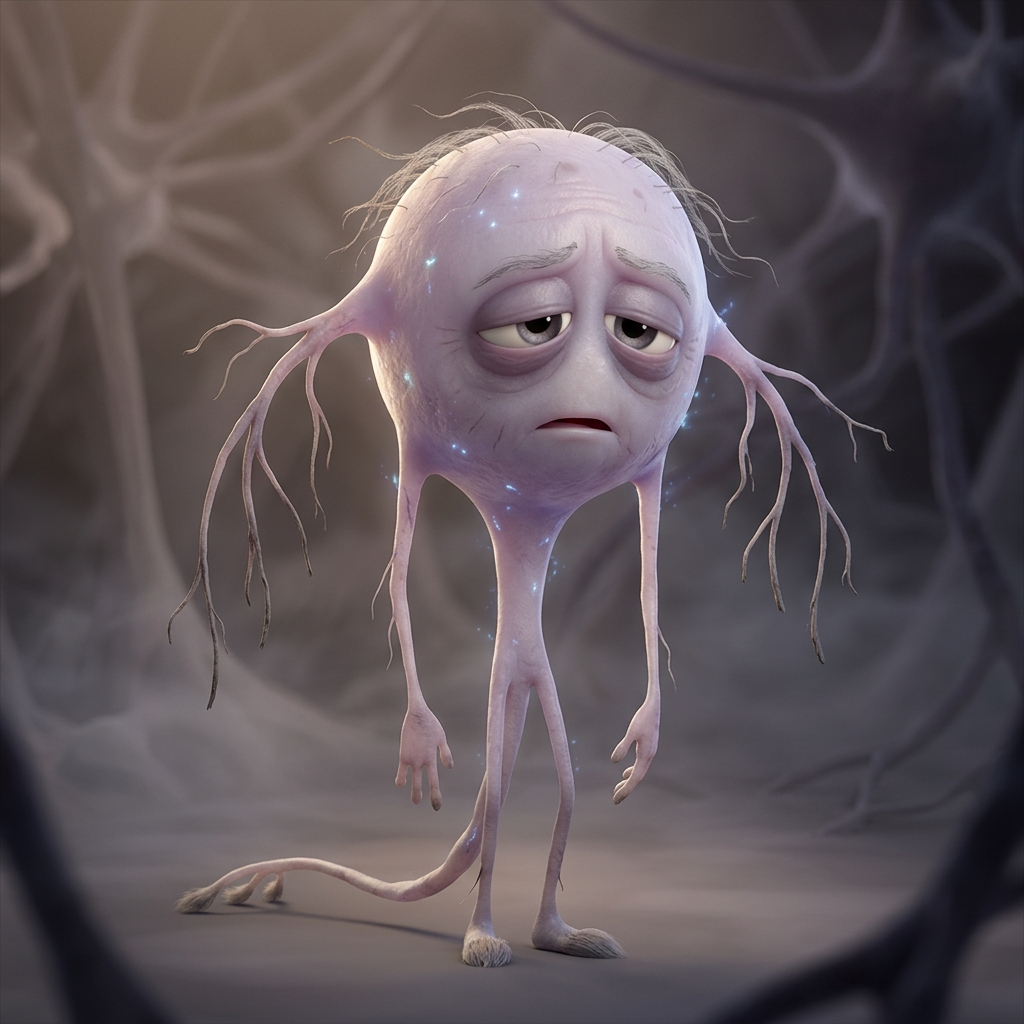


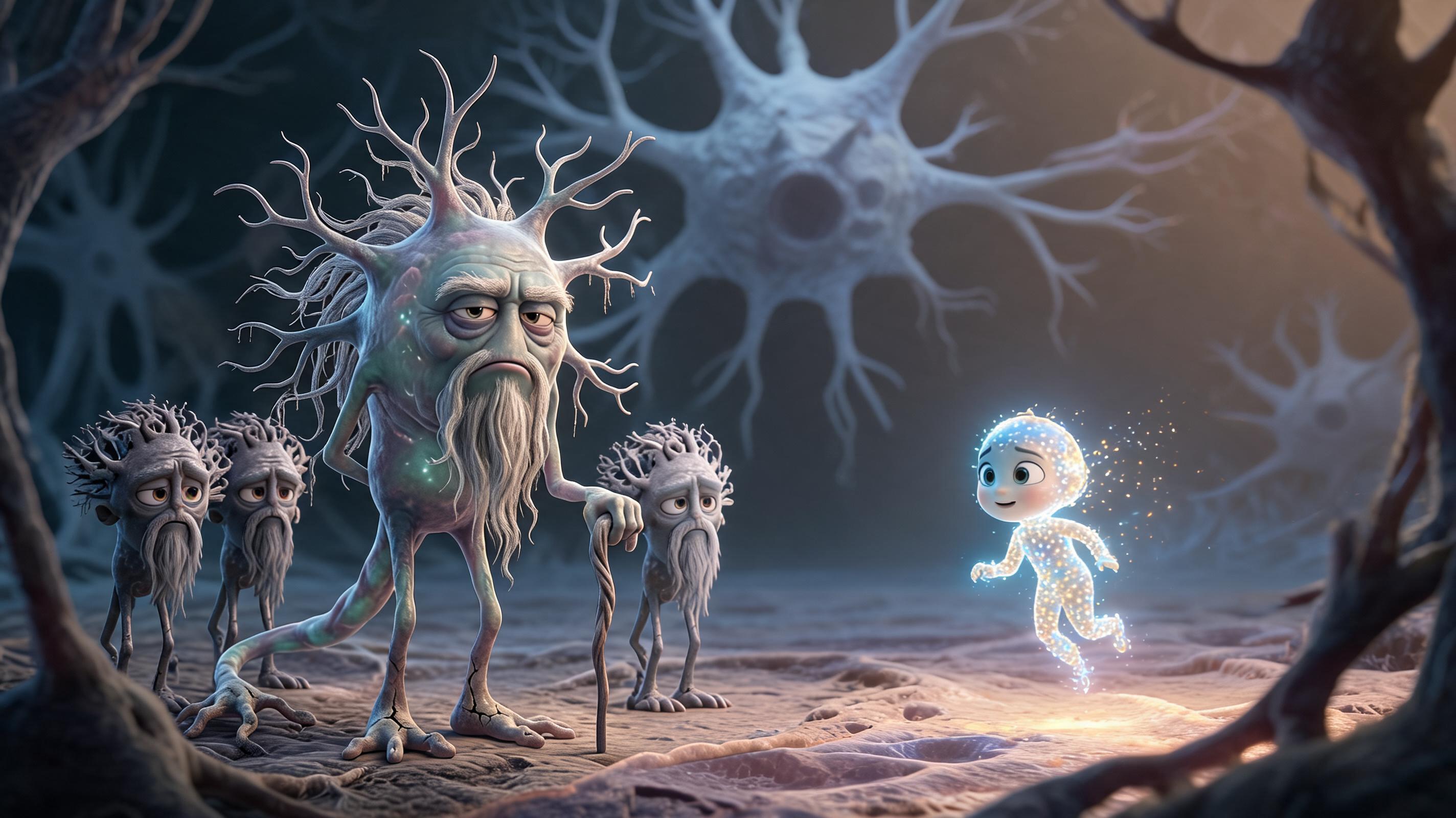




Art style: 3D Pixar. Full-length view, the entire figure visible from head to feet, standing upright, centered — an ancient, weary neuron cell brought to life as a gentle character. Its rounded soma is a translucent pale-lavender bulb, softened and slightly sagging with age, dotted with faint wrinkle-like creases. Long branching dendrites droop downward like tired old arms and thinning gray hair, their tips frayed and dim. A single elongated axon trails behind like a worn tail, ending in small tuft-like terminal feet that serve as its base. Two large, drooping eyes with heavy lids and dark under-shadows convey lost hope; a small downturned mouth sighs softly. Dull, faded bluish spark-flecks flicker weakly across its membrane. It stands hunched in a dim, hushed inner-brain landscape of soft misty synapse-threads and shadowed neural pathways stretching into the distance. ━━━━━━━━━━━━━━━━━━━━━━━━━━━━━━━━━━━━━━ FINAL STYLE ENFORCEMENT (this is the authoritative rendering directive — it overrides any style wording elsewhere in the prompt): Render this image in the following art style: Pixar-style 3D computer animation (Pixar / Disney feature-film look) — fully volumetric 3D rendering with rounded dimensional forms, soft subsurface-scattering skin, physically based materials, soft global illumination, warm cinematic key light, gentle depth of field, vibrant family-friendly colours. CRITICAL: EVERY element — characters, foliage, trees, animals, water, sky, props and the entire environment — must be rendered as polished 3D CGI with real depth and form. This is NOT flat 2D illustration, NOT a watercolour or storybook painting, NOT cel-shaded anime. Every surface, skin, fabric, material, and environmental element must be rendered in this idiom.
Free to start · Generate videos and images with AI in seconds