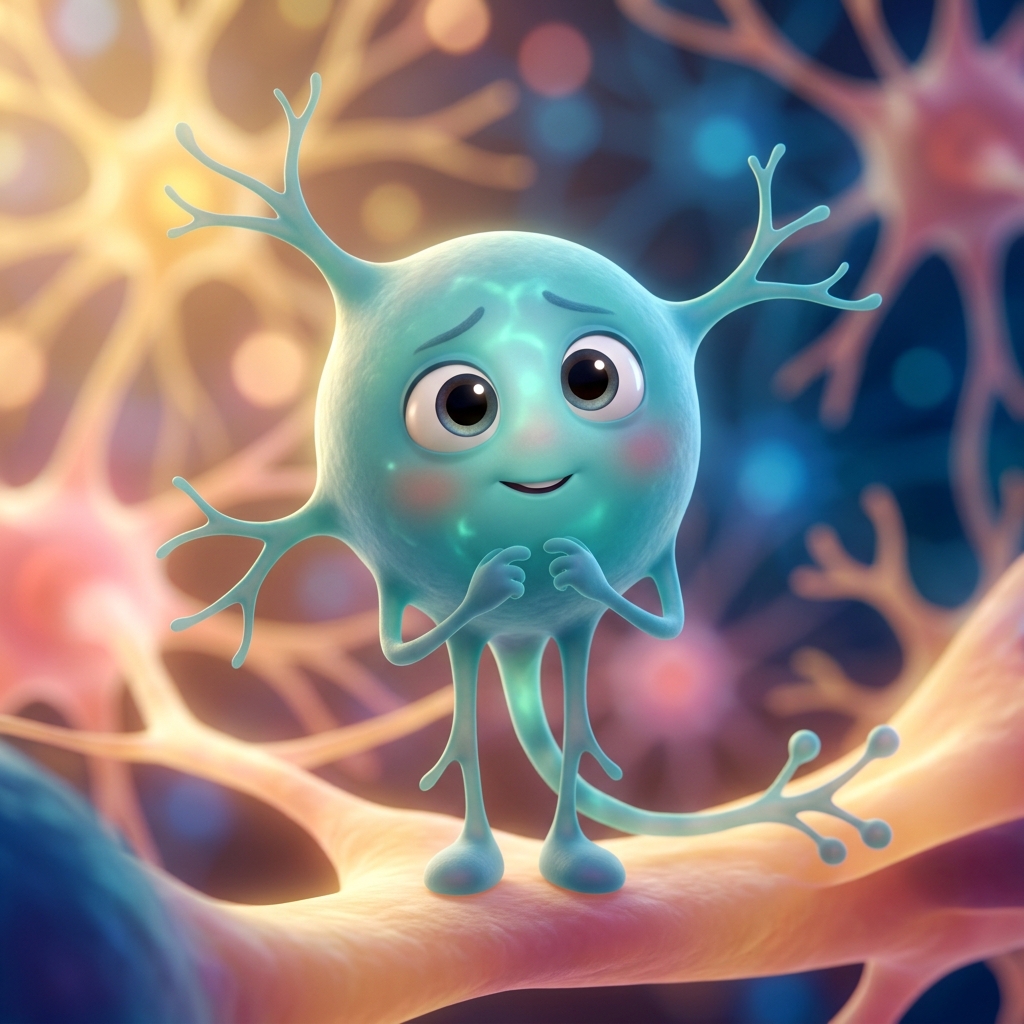







Art style: 3D Pixar. Full-length view, the entire figure visible from head to feet, standing upright, figure centered — a young, shy neuron character imagined as a small round-bodied creature. Its main body is a soft translucent teal-blue orb with a faintly glowing inner core, from which slender branching dendrite arms and stubby dendrite legs extend, and one longer tail-like axon trailing behind, tipped with tiny bulb-shaped synaptic terminals. Large curious dark eyes with bright highlights, small hesitant smile, gently blushing cheeks, expressive tilted head showing timid wonder. Its arms fidget together shyly near its chest. It stands on two little rounded nub-feet resembling soft synaptic pads. The setting is a warm, glowing interior neural landscape with soft blurred branching cells and gentle bokeh lights filling the sides. ━━━━━━━━━━━━━━━━━━━━━━━━━━━━━━━━━━━━━━ FINAL STYLE ENFORCEMENT (this is the authoritative rendering directive — it overrides any style wording elsewhere in the prompt): Render this image in the following art style: Pixar-style 3D computer animation (Pixar / Disney feature-film look) — fully volumetric 3D rendering with rounded dimensional forms, soft subsurface-scattering skin, physically based materials, soft global illumination, warm cinematic key light, gentle depth of field, vibrant family-friendly colours. CRITICAL: EVERY element — characters, foliage, trees, animals, water, sky, props and the entire environment — must be rendered as polished 3D CGI with real depth and form. This is NOT flat 2D illustration, NOT a watercolour or storybook painting, NOT cel-shaded anime. Every surface, skin, fabric, material, and environmental element must be rendered in this idiom.
Free to start · Generate videos and images with AI in seconds